


 Flash Mentoring ezine
| Format |
Price |
| Paperback | $16.95 |
| Nook | $9.99 |
| Kindle | $9.99 |
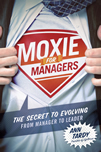
Moxie for Managers
The Secret to Evolving from Manager to Leader
People are hungry to make a difference and achieve but they are hardwired to hold themselves back and sabotage success. When innovation, progress, and execution matter, your job as a leader in the middle is to help people get out of their own way.
Get ready to discover the moxie mindset formula and how you can influence it through your day-to-day interactions with people. By understanding the behavioral influences that intrinsically impact people every day, you can herald an approach to work that echoes Jack Welch’s and Anne Mulchaey. Get ready to explore the art and science behind people successes (and failures) that will catapult you into moxie manager status and leave mediocrity behind forever.
Doing extraordinary things is not limited to the executive suite. But somewhere between executives and contributors, the halls are bursting with complacency and mediocrity. Corporate America is starved for moxie in their managers. The time for middle leadership to shine is now!
Endorsements
Practical and inspiring, Moxie for Managers made me appreciate even more the value that influence has in leading effectively. It proves that anyone at any level of an organization can exert influence and effect change.With this book as a guide there are no more excuses for being stuck in relationships with others; there are only opportunities to bring out the full potential in people.
William Waszak
Chief Information Officer, Scotts Miracle Gro
Moxie for Managers changed me. Before learning about the principles that influence people, I was relying on congeniality and a positive attitude to motivate others. Now I know the secret to being an effective leader and I’m leveraging it every day. Ann’s work is like nothing I have ever learned in formal or informal training. It has impacted my ability to lead and be followed not only at the office but in my personal life as well.
Gailene Cowger
Manager, Baird & Warner, Orland Park Office
The mentoring guru, Ann Tardy has created a map for those who are ready to leave management behind and become inspirational leaders! Moxie for Managers is the distillation of years of experience and observation by a thought leader with a keen mind and clear focus. As one who has benefitted greatly from Ann Tardy’s guidance, I highly recommend Moxie for Managers to those who want to do it better, whatever “it” is!
Wendy Willow Wark
Director Employee Relations & Diversity / EEO Officer, MTA Metro-North Railroad
Moxie for Managers is not just a fantastic read about how people successfully deal with other people. It is also a handbook for how to exert influence over yourself. The bottom line, when we get out of our own way and get out of other people’s way, magic happens.
Glen Rossman
Former Tax Director, Cisco Systems
Raving Reviews
In a world full of consultants telling us what we MUST do to stay in business, or placing the fear of God (or bankruptcy) in us if we don’t follow their “program…Here comes a breath of fresh air - Moxie for Managers by Ann Tardy!
Ann’s approach uses encouragement to try things a little different than what we've been doing, without the fear mongering or “my way or the highway” demonstrative dogma! Instead Ann draws on her incredibly diverse credentials in business, law, and leadership to make well founded arguments for a change to a cooperative management style – that creates partnership with our staff, while maintaining a functional hierarchy. Don’t get me wrong: this is no “Kum ba yah” – 60’s style free spirit…No, these are solid management initiatives that bring people together to set goals and then release them to complete their appointed tasks. The end result is empowerment coupled with engagement! Our people feel like they are PART of the solution – an important cog in the wheel – and this creates self worth as well as corporate results!
So….if you are looking for a draconian book on managers – or perhaps you want a “don’t bruise their karma” type book – forget this one! What you WILL get are practical, usable and VALUABLE tools that you can implement immediately – and tweak if you feel it works for you. In fact, for many of Ann’s “Influencing Tenets”, she offers alternatives, options, or variables…bottom line – quit reading this and start reading THE BOOK!!!
Gary Lichtenheld, President
Terrace Supply Company
If you have people in your organization who could benefit from leadership training, then look no further than Moxie For Managers - The Secret To Evolving From Manager to Leader, by Ann Tardy.
I have read many leadership "theory" books, but most of them fall flat when it comes to the "how to" of leadership. What makes Moxie For Managers so different is that this book calls for "action" - and shows the reader the path to influencing and leading others. The author is, and has been, successful in a variety of roles in her career - as an employee, a partner, a motivational speaker, and an entrepreneur - and she writes from the perspectives of each one of these roles. With her experience and expertise in all of these positions, she has created a book that is easy to read and easy to understand - and it doesn't matter if you are a first-time manager or the CEO of a company.
I currently serve as Vice President and Sales Manager in a small business, and in this role I wear many hats. However, my most important responsibility is developing the talent of our entire team - and Moxie For Managers is a perfect blueprint to do just that. Once I realized the positive impact this book could have on our organization after reading it, I created a voluntary "book club" for our management team to meet regularly to discuss this book chapter by chapter. Through reading and dissecting this book, our people have grown from reactive managers to proactive leaders. They are constantly thinking, sharing, and using concepts from the book to improve themselves and become more efficient, effective influencers to those around them.
Throughout the book, Ann Tardy creatively teaches the reader the secrets to influencing - at all levels of any organization - and the art of how to use that influence to lead effectively. The most exciting part for me is to see our new "leaders" passing on the things they've learned from this book to their individual team members - the trickle-down theory in action - and the Moxie in our company is now growing at every level!
Thank you, Ann Tardy, for creating a tool that can help businesses of any size get out of the stagnation of mediocre and develop team members who strive for excellence. Because of YOUR influence, we are now moving from "business as usual" to "business as extraordinary"!
Brian Overheidt , Vice President
Terrace Supply Company
Wow, talk about self- and coworker-motivation. I received this book from the LT member giveaway program and immediately began highlighting. I just graduated from college and, although I am not in a management position currently, I feel like this book has enabled me to get in the "Moxie" mind-frame to do better work; and to make my work experience better for me and for my coworkers. Ann Tardy's tips for becoming a leader at work also apply to other parts of my life now: classes, projects, interviews, and even friendships. After reading, I felt empowered to make better decisions and to make my experience what I want it to be. Excellent read for those who want to manage both work relationships and life relationships. Highly recommend, and have gotten feedback from friends that it has inspired them to do their best at work and at home also.
Allizabeth Collins
This
book in a way has some sad truths; the average office is a sea of mediocrity,
with people who are passively or actively trying to pull you down. There may be
situations and management that are not actively helping you to be successful.
This book, Moxie for Manages, gives some basic tenets about people's motivations
and examples and ideas to model for success in helping people to do their best
even when the situation is not the best.
The tenets really caught my eye,
the first one especially. It is:
"We all think the world revolves around
us." Oh my goodness, I have to remember that every day when dealing with people.
We are the center of our circle, and likewise, the person you are dealing with
is the center of THEIR circle, and unless you are a part of their inner circle,
you touch them on a tangent point at best. This is very deep advice, and I
recommend you ponder on it when you deal with people. You are touching them at
one point on their circumference--how are you going to influence
them?
The next tenets give you a clue: We are dying to make a difference,
we want to be winners, we all want control, we want to feel important, we want
respect, admiration and appreciation. These five tenets actually all say the
same thing, in a different way; as the center of their circle, people want to be
recognized and appreciated. The moxie manager can use that basic principle of
human psychology to motive, drive and implement their plan, and so the examples
follow to illustrate how that was done in some challenging
situations.
This book covers difficulties you, as a manager, especially a
new manager, are going to face (what if you are now managing the persons who
were rejected for your job?)
This is easy, interesting reading, and I
think it would be helpful to anyone in the thankless task of middle management,
or anyone taking over a firm who faces deep challenges in becoming successful as
a leader.
Joanna Daneman
Middletown, DE
The term moxie, when used in a
common sense, is synonymous with courage or spirit. Few people define and
utilize this gift better than Ann Tardy who in her most recent book MOXIE FOR
MANAGERS: THE SECRET TO EVOLVING FROM MANAGER TO LEADER. In this up front,
seemingly off the cuff book of instructions and guidance Tardy offers some
uncommon common sense and if the reader follows her through to the end of the
book, it is doubtful that significant change in the way work AND life will be
viewed and altered.
A bit is the author's background provides a few
insights as to why she is able to write such a helpful book. 'From Silicon
Valley corporate attorney to award-winning advocate for middle managers,
mentoring expert, and adventurer, Ann Tardy has never met a dull moment or a
person who wasn't dying to make a difference. Considered one of the top thought
leaders on transforming middle management, Ann helps visionary organizations
unleash moxie where they need it most - in the middle. By combining the art of
management with the science of behavioral economics, Ann interprets the stories
we tell ourselves, revealing how we are each hardwired to hold ourselves back.
She creates a new emotional context to prepare middle managers for executing in
complex environments. Since 1995 Ann has been using moxie as a strategic
advantage. As a start-up attorney in Silicon Valley, Ann first discovered it
while closing over $2 billion of venture-backed financings at two of
California's largest law firms. While dancing with her entrepreneurs, Ann
realized that it's not willpower that separates the magnificently successful
from the mediocre, but moxie. Ann went on to lead the legal departments of two
high-tech start-ups, taking one company public and the other to acquisition.
Following her in-house tenure, Ann launched her own law firm, growing it to 75
loyal clients before merging it with a larger firm. She has been honored as an
Outstanding Business Woman of the Year by the American Business Women's
Association and with the McGraw-Hill Vanguard Award for her contributions to
employees at McGraw-Hill and Standard & Poor's.' And there you have it - or
at least her credentials.
What Ann Tardy does in this book is teach us
how to manage from the middle. She focuses on Elton Mayo's 6 ageless factors
that influence intrinsic motivation: 1. purpose and meaning, 2. making a
contribution/difference, 3. control and flexibility, 4. use of our talents and
abilities, 5. supportive colleagues, 6. appreciation. From these early stated
starts Tardy takes us through the concept of 'moxie' or Chutzpah in instilling
these factors in the people around you, those who see themselves as employees
ranter then as team. And it is this transformation of the role of manager into
that of a superhero, simply by empowering correctly those people we manage and
help them discover their true abilities and moxie.
Sounds simple in a
brief outline, but spend some quality time reading the very bright Ann Tardy and
you're bound to come under her spell. No, you're bound to grow up on your own
and wonder why you never had these gifts inherently available. They have been
and are, with the empathetic coaching of Ann Tardy.
From the Coach's words, October 19, 2011
Grady Harp
Ann Tardy hit home with her pointers to being a better manager! The anecdotes and specific, real life examples of bosses demonstrating effective leadership make this a fantastic book. I especially liked her "asking the second question" section. We've made changes at our business based on some of her suggestions and have had very positive feedback from the rest of the team. Note: I said "team", not "employees".
Lynn Christensen
Chicago, IL
When I read something and make
notations on a lot of pages, that's a good sign that I'm liking it . . . that
was certainly the case with MOXIE FOR MANAGERS (Fish Head Publishing) by Ann
Tardy--founder and chief catalyst of her own company, LifeMoxie.
The
author promises in her subtitle to share THE SECRET TO EVOLVING FROM MANAGER TO
LEADER.
She delivers on this promise, too, with page after page of useful
tips that can best be summarized by this one:
* If you want to be a moxie
manager, your objective must be to make people as successful as possible; not to
make yourself, your company, or your shareholders as successful as possible.
Just people. When you serve people's success first, your success will be
guaranteed and exponential. This is the key to moxie leadership. It is
incredibly challenging, but unbelievably fulfilling.
In addition, I liked
Tardy's explanation of something called the Second Question:
* As the
Second Question. My good friend Cherryll Sevy introduced me to her theory of the
"Second Question." Most people ask one question and then hijack the conversation
with their own story, similar experience, or commentary. For instance, typical
people may ask the standard first question, "What do you do?" When they hear the
answer, they instantly jump in with, "That's interesting. I have a friend who
does that." Or "I used to do that." Or some comment like, "I bet the market has
not been good for you."
The self-confident, self-assured person does not
need to entertain, impress, and be interesting. Instead they focus on being
interested and connecting with the other person by staying interested in them.
People who are committed to connecting always ask a Second Question, such as,
"How did you get into that career?" or "What's a typical day like for you?" or
"What is that experience like?" or "How does it feel to run that department?" or
"What's it like to work with new clients?" My favorite Second Question is "What
do you love about your job?" People love talking about themselves, and in the
process I learn so much about them with this straightforward Second
Question.
Lastly, what made the book so valuable for me was the fact that
it contained many real examples--such as the following:
* Green Bay
Packers coach Mike McCarthy similarly leveraged the diagnosis bias to influence
champion behavior in his team when they needed it most. The night before the
Super Bowl, coach McCarthy had each player and coach fitted for a Super Bowl
championship, ring. The next day the Green Bay Packers won Super Bowl ILV over
the Pittsburgh Steelers, 31-25. Did Coach McCarthy predict the win or just
influence it? Was it simply presumptuous and brazen or incredibly
strategic.
MOXIE FOR MANAGERS is one of my favorite books of the year...OK, OK, it's still early...however, I doubt that opinion is going to
change; in fact, the more I think about the tidbits contained therein, the
more I go back to review them.
"Eclectic Reader" Blaine Greenfield
Belle Meade, NJ
Every manager's dream is to have fully engaged employees, but it simply doesn't happen overnight nor without some guidance. Moxie, in a nutshell, "is an enthusiastic, uncompromising movement toward a goal in the face of obstacles, with ruthless integrity." If you are an insecure manager without the skills to guide your employees, you cannot expect an enthusiastic workforce nor one that will compensate for your weaknesses. Everyone knows that behaviors can be learned, but you don't want your employees to learn to be slackers or complacent at the cost of the company's bottom line because you can't help them.
Ann Tardy, the founder of LifeMoxie, claims that "we can influence someone's intrinsic motivation, and similarly we can influence them to use their moxie and operate with a moxie mindset." In essence, we all have ten basic, Influencing Tenets that influence our outlook on life. These Tenets naturally carry over into the office and affect everything from how we deal with others to the overall productivity of the workforce. The impact can be a negative one if a manager simply manages and does not evolve into a leader. Ann lists these Influencing Tenets and discusses how they can be used to ones advantage by using a bit of moxie in a leadership position. Essentially, when used properly become one's "Battle Cry."
There are examples of employees who already have that moxie. Ann discusses why people like NYNEX super salesman, Rob, succeeded where others couldn't, wouldn't, or just didn't feel like it. She dissects the reasons why he overcame insurmountable odds to sell cell phones when they were barely on the radar and no one wanted them. Recognizing the ten basic tenets and using them to our advantage will help turn a dowdy manager into a leader. For example, most of us can recognize when someone is starving for attention, but Ann shows us how to turn this annoying behavior around and use it to the advantage of the company. Anyone recognize the person who never shuts up or the drama queen in the office? We all know them, but they can be dealt with and you'll learn how.
This book, unlike many other business books, is not so heavily structured that after the first chapter you want to fall asleep. It is a motivational book with a lot of moxie, but it is also conversational in nature. There are numerous examples of her own dealings with employees and family members to illustrate a point. For example, she talks about an incident with her stepson, Jack, and how she had to work on her own attitude and preconceived notions about people. The conversational aspect in no way diminishes this work, but rather enhances it. Ann was able to cover an enormous amount of business territory without becoming tedious. At the end of each chapter are sidebars with suggestions as to how a manager can put into action what they've learned in the chapter. If you want to become an effective leader instead of a people herder, this may be a book you'll want to consider!
D. Fowler "Dragonfly77"
Vermont
This is a must read for anyone who wants to be a manager and for people who want to know what to expect from a good manager.
Ann Tardy's approach to management is that you cannot motivate people, but you can learn how to help people motivate themselves. The manager's job is to influence this internal motivation by understanding what is important to each person. By working on helping people fulfill what is important to them, make them feel respected and valued (something we all want) in turn inspires loyalty and enthusiasm. When I worked for the bad managers, I felt I was there to help them. When I worked for the good managers, I felt they were there to help me. This books helps helps explain what specific actions made me feel that way. Ann Tardy makes it surprisingly simple.
Moxie has many discussions and specific example how to motivate people. People are very similar in some basic respects. I recognized myself in a number of examples in this book. Bad managers took credit for my work or assigned achievements to their entire team, my good managers went out of the way to give me credit. I felt appreciated, I felt my hard work was noticed, I worked even harder.
Ann Tardy discusses how to give flexibility and control to the members of your team which improves morale and overall productivity. Again, examples are simple and specific. It becomes clear why we all hate to work for micro-managers and why micro-managing is counter-productive.
I liked the section on Participatory Bias. When people come up with solutions to a problem, those solutions gain immediate support because they were generated by the people rather than the solutions that were imposed by the management.
Each chapter ends of with a set of specific actions a manager can take to apply the skills discussed in that chapter in their work place. These actions are simple and realistic, and would apply to any work environment.
This book is a must read for any manager and any organization. What the book suggest is not difficult to achieve, but requires discipline and willingness to give up some control. But there is a huge payback for those actions. I am going to post a recommendation for this book at work and I hope that every manager in the organization reads it.
Ali Julia
Boston, Mass.
Today is even more important to
make sure that those in the workplace feel appreciated and respected in their
roles within the company. In many instances this begins at the top, with the
managers or supervisors that are directly overseeing them. In MOXIE FOR
MANAGERS, Ann Tardy stresses the importance of not just being in a position of
leading but actually doing it.
Using not just her personal experiences
but those of others as well, the book outlines who those in positions can do
their part to making the organization run well, beginning with the way they
treat the team. As someone who spent 10 years in hotel management, I could
definitely agree with Tardy as she explained that sometimes we affect the morale
and the attitude of those in our charge just by the way we treat them as well as
approach our position. A leader should be seen as someone who has the best
interest of the team in mind. It isn't about telling others what to do. It's all
about showing them through example.
Another important point that the book
makes is the art of communication. We have all heard that it's not what you say
but how you say it, but the book shows that both are just as important. Make
sure that you are being concise in what you expect from your team and make
yourself available for those who might need more direction and explanation. All
of this goes hand-in-hand as we work together to be as production and profitable
as possible. Having people fear you is not the aim of a leader. Having them not
want to disappoint you and themselves is much more important.
Presented
as only a leader could, MOXIE FOR MANAGERS (The Secret To Evolving From Manager
To Leader) is the kind of book that management teams and those who aspire to
ascend to the level of management should read and refer to. It's not something
that will happen overnight, but when it becomes your aim to treat people the way
you want to be treated and respected it all becomes easier. Definitely an
invaluable resource.
C.A. Webb "Conversations Book Club"
Jackson, MS
Moxie For Managers -The Secret To
Evolving From Manager To Leader by Ann Tardy is about motivating people to
become the best they can become. People with the Moxie mindset are enthused,
resourceful, innovative and resilient in the face of adversity. And so, a
successful work product is something that employees create, earn, generate,
re-generate and sustain
over time. As a middle management person, your job is
to influence intrinsic motivation in a positive way.
There are 10
Influencing Tenets that constitute the boundaries for you to influence or
motivate others to action. For instance, we need meaning in life. Most of us
would like to make a positive difference. Everyone wants to be a
winner.
Most people crave control and a feeling of self-worth. Perhaps
most importantly, people fear rejection.
Mayo identified through
experimentation at least six ageless factors that influence intrinsic
motivation. These factors include purpose, making a contribution, control and
flexibility, the constructive use of talents, supportive colleagues and
appreciation for a job well done.
Moxie for Managers addresses ways of
improving communication in an organization. These ways include an empathetic
approach, listening intently, speaking to be understood, setting
realistic
expectations, providing quality feedback and suspending judgment until a clearer
picture emerges.
Napoleon Hill introduced the concept of a Mastermind
Group in Think and Grow Rich. He surmised that two people working toward a
common goal will create a third force which is invisible and intangible- a third
mind. And so, the brainpower of two or more people working together concurrently
is synergistically more powerful than the sum of the constituent parts working
separately.
Sometimes, people wittingly or unwittingly sabotage efforts
or commitments for a whole variety of reasons both conscious and unconscious.
Moxie for Managers provides ways to unravel sabotage in any project or
undertaking. These ways include refocusing on the goal ,celebrating effort,
advocating for discovery over proficiency, mitigating risks, de-constructing
road blocks, leveraging mentoring and piloting or modeling. Mentoring is the way
collective institutional knowledge is exchanged among people. Sometimes, the
information communicated isn't written down anywhere. With mentoring, your own
employees are developing each other. Life doesn't get any simpler than that for
developing employee knowledge and perspective. In business, there are
transactional relationships and transformational relationships. A transactional
relationship is as simple as processing a customer order. A transformational
relationship is an alteration, a change or shift or new adaptation. In your
interactions with others, your approach could be purely transactional or it can
be transformational. i.e. How best can I support you in succeeding in your
business? Moxie for Managers is a bold exploration into new and inventive
approaches toward motivating people, enhancing ideas, promoting products and
engaging customers. The presentation is easy to read, understand and
apply.
Wow, talk about self- and coworker-motivation. I received this book from the LT member giveaway program and immediately began highlighting. I just graduated from college and, although I am not in a management position currently, I feel like this book has enabled me to get in the "Moxie" mind-frame to do better work; and to make my work experience better for me and for my coworkers. Ann Tardy's tips for becoming a leader at work also apply to other parts of my life now: classes, projects, interviews, and even friendships. After reading, I felt empowered to make better decisions and to make my experience what I want it to be. Excellent read for those who want to manage both work relationships and life relationships. Highly recommend, and have gotten feedback from friends that it has inspired them to do their best at work and at home also.
Dr. Joseph S. Maresca
Bronxville, NY
Over the years there have been hundreds of books about
leadership. There are many theories about what makes a good leader, some even
suggesting that leaders are born, that there is something innate in certain
people that make them natural leaders. As business moves from the old command
and control structure into the more collaborative workplace, leadership is
becoming crucial to the success of individual careers as well as
businesses.
In my experience, far too many books on management and
leadership fail to really deliver on their promise. I believe that Moxie for
Managers over delivers. Ann Tardy, the author, delivers a very comprehensive
framework for any manager to evolve into a true leader of people.
While
the book implies that its target audience is middle managers, I believe anyone
who interacts with people can/will benefit from reading and applying the
principles in this book. As Ms. Tardy points out, "We lead people." It truly
does not matter if they are employees, volunteer workers, friends or family
members. We have the opportunity to lead the people in our lives in a more
positive way.
The approach Ms. Tardy advocates is to understand what
motivates people - she gives 10 Influencing Tenets - and "... to leverage these
Tenets to influence people's intrinsic motivation in order to impact change at
individual and organizational levels."
The author draws on her years of
experience as a lawyer working in Silicon Valley during the dot com heyday.
While law was her profession, understanding people was her passion. She enjoyed
a very successful career because she was very diligent in understanding what it
took to be a leader, not a manager.
The book is very well written and
very easy to read. It is a bit long but I would not suggest that any of the
material is not important. This is not a book to be skimmed. The information is
extremely valuable for those who wish to understand human behavior and transform
themselves and others. There is a lot of human psychology in the book, all
explained in simple layman's terms. You will come away with a much better
understanding of what makes human's tick.
While the book constantly
discusses how to become a leader and the principles which influence others’
lives, you will naturally find yourself looking at your own behavior.
The
book is filled with very interesting stores which serve to illustrate the points
the author is making. There are plenty of very powerful questions scattered
throughout the book. If you are a coach/mentor, you can use these questions to
greatly improve your coaching/mentoring.
Near the end of the book Ms.
Tardy asks the question, "If we are going to spend so much of (our time) working
with others, why wouldn't we want the experience to be as productive, valuable,
satisfying and amusing as possible?" I suspect that most people would answer, I
would but ... This book is all about understanding the obstacles we throw up and
why we allow obstacles to obstruct our path to a better, more productive
life.
Highly recommended. I suggest that you read it, then keep it handy
as a reference tool and refer to it often.
John Chancellor, "Mentor Coach"
Spring Hill, TN
Moxie is an overused Yiddish
word usually meaning a positive "can do" attitude. In this book `moxie' is
defined as an attitude or mindset that is characterized by passion,
determination, and enthusiasm in regards to earning a living. Ann Tardy, the
book's author, has built a management consulting business based on moxie as a
management philosophy. This book explains that philosophy.
Tardy is unique among management consultants in that
she distinguishes between `leadership' and `management' recognizing that real
successful enterprises depend far more on inspired leadership than even
effective management. She is all about an engaged workforce led by enthusiastic
leaders. Her method involves empowerment, enthusiasm, flexibility, and
self-deception. This last should be explained to mean each employee of an
enterprise regardless of position should believe absolutely that his or her job
is essential to the success of the enterprise. Tardy warns of the dangers of
creating a "what's in it for me" attitude in the workforce. She strongly
advocates each member of any work force be instilled with the attitude that
their personal success is indistinguishable from the success of the enterprise.
In short her goal is to ensure that the `moxie' attitude characterizes any
organization from the CEO to the loading dock workers. A moxie attitude is the
core value of her philosophy and in her opinion will make any organization with
resilient, flexible, and productive. She may well be
right.
Retired Reader
New Mexico